Car List API v1.6.0: A Better Developer Experience
Meet the redesigned dashboard, VIN Decoder Beta, official PHP SDKs, expanded powersports discovery, and refreshed automotive data in Car List API v1.6.0.

Car List API v1.6.0 is now live, bringing together the improvements developers interact with every day: a clearer dashboard, simpler integration options, more flexible powersports discovery, VIN decoding, and refreshed vehicle data.
This release is about reducing friction between creating an account and shipping a dependable vehicle-data experience. Whether you are building a year, make, and model selector, adding powersports search, decoding VINs, or monitoring a production integration, the tools around the API should now feel more connected and easier to manage.
Area | What changed | What it means for you |
|---|---|---|
Dashboard | Redesigned account, usage, token, and billing views | See the state of your integration without hunting through separate screens |
VIN Decoder | New beta endpoint with its own usage allowance | Turn a valid VIN into normalized vehicle information through the same API account |
SDKs | Official Laravel and framework-independent PHP clients | Integrate with typed responses and structured exceptions instead of writing every request by hand |
Powersports | New type-aware lookup paths | Start with motorcycle, ATV, utility vehicle, or another supported type and narrow results sooner |
Vehicle data | Production-verified August 2026 refresh | Access 2,690 newly added automotive records and 35 verified updates through existing endpoints |
A dashboard designed around real integration work
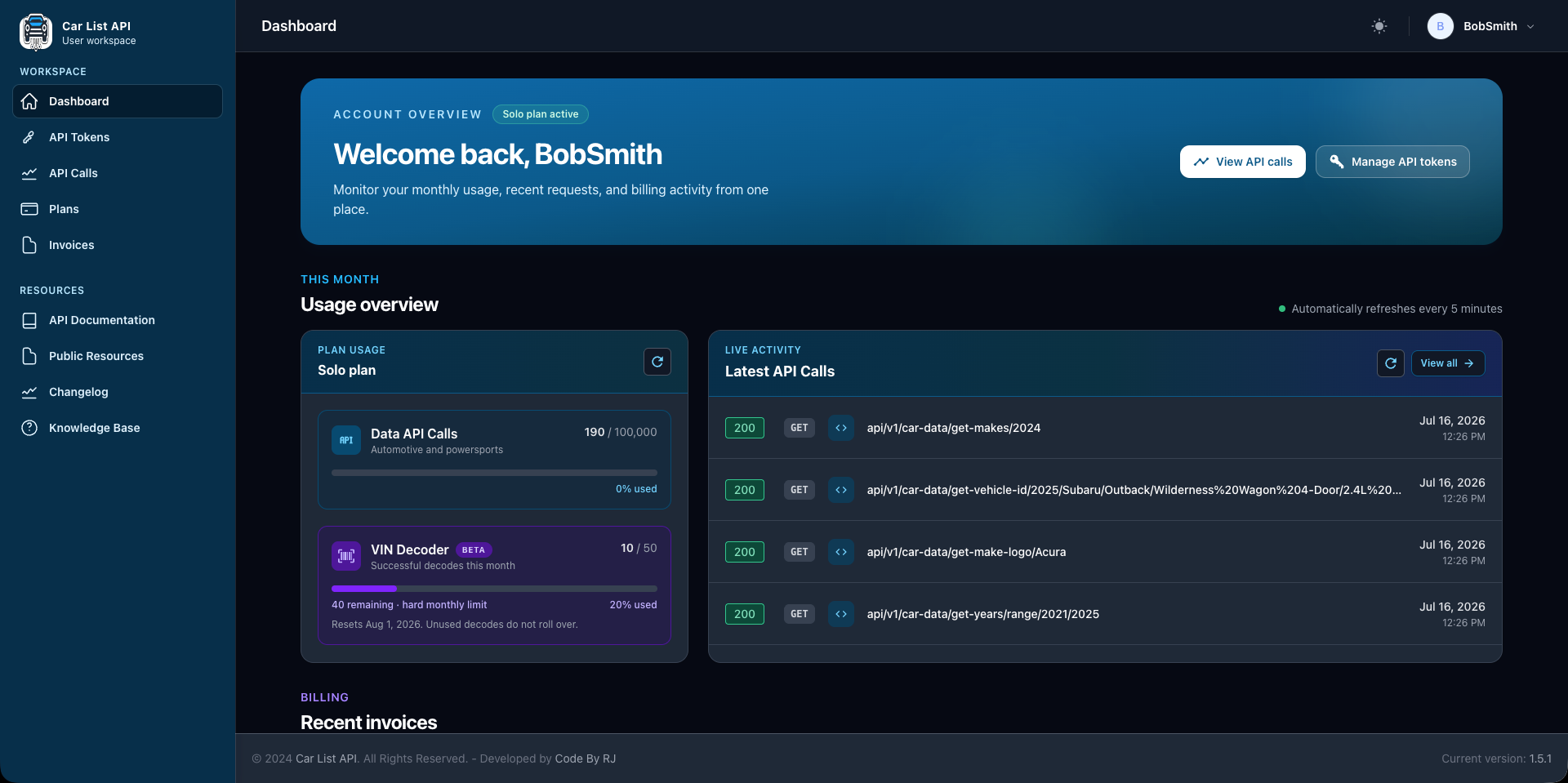
The redesigned dashboard puts the information needed to operate an integration closer together.
API and VIN Decoder usage are presented as separate allowances, making it easier to understand what your application has consumed and what remains. Recent request activity provides more context when you are testing an endpoint or investigating a response. Token management gives you one place to create credentials, configure permitted server IP addresses, review expiration, and rotate access when needed.
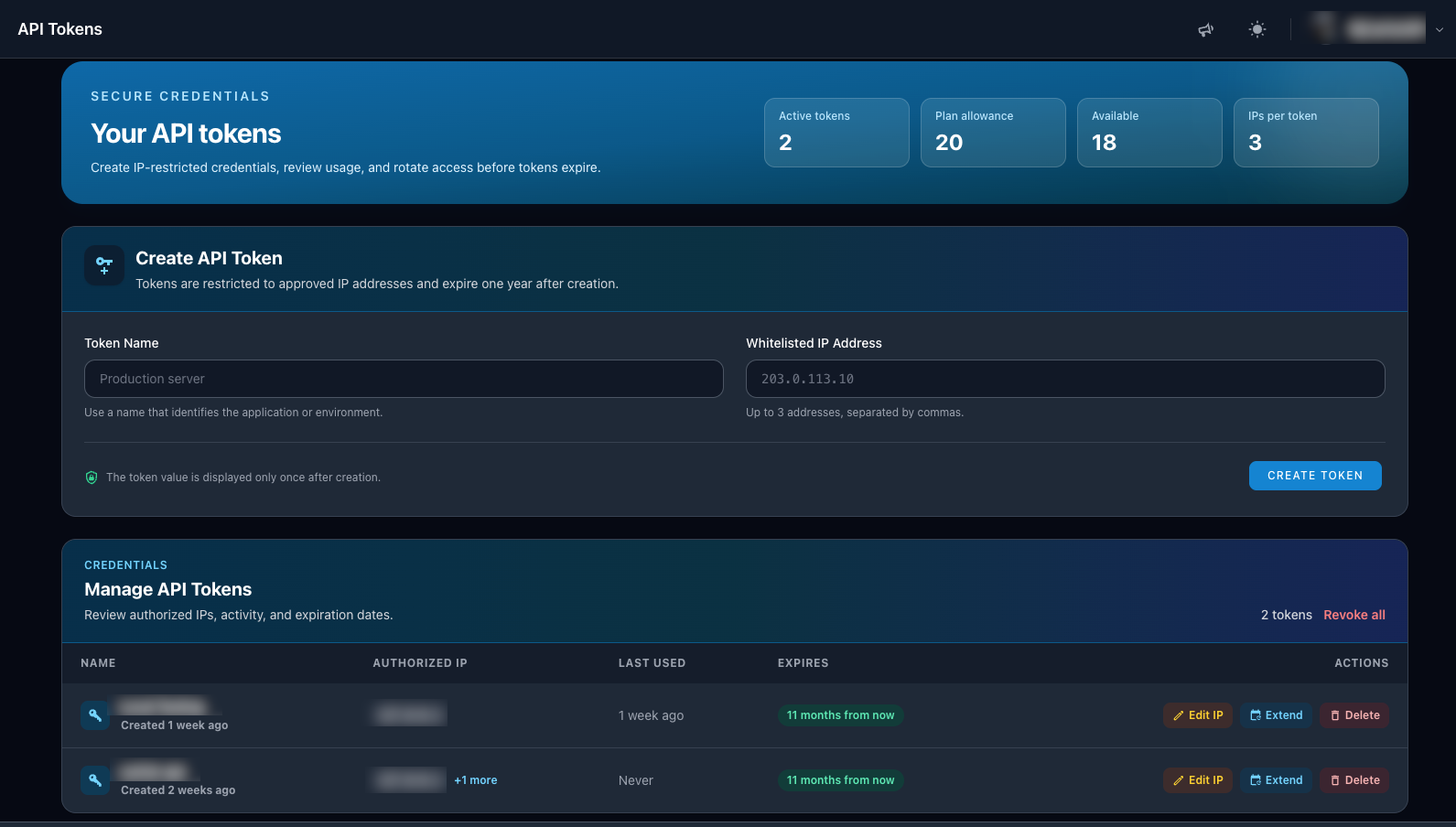
Subscription, billing, and invoice information have also been brought into the same control-panel experience. The result is a clearer path from choosing a plan to creating a production token and monitoring the application that uses it.
For teams, this means less guesswork. You can quickly answer practical questions such as:
Is the account and subscription active?
How much API or VIN usage remains?
Is the production server IP permitted by the token?
Are requests succeeding, being rejected, or reaching a usage limit?
When does a token expire?
Visit the Car List API dashboard to explore the updated experience.
VIN Decoder Beta joins the API
Car List API v1.6.0 introduces VIN Decoder Beta for eligible plans.
Send a validated 17-character VIN to the versioned decoder endpoint and receive normalized vehicle information through the same authentication model used by the rest of Car List API. The decoder handles invalid input, provider-declared decode failures, partial results, and temporary provider issues without exposing upstream implementation details.
VIN Decoder usage is tracked separately from automotive and powersports API usage. This makes capacity easier to understand: ordinary vehicle lookups use the data API allowance, while successful VIN decodes count toward the plan's dedicated VIN Decoder allowance.
Because the feature is in beta, integrations should continue to handle partial results and avoid inventing values when a VIN does not provide every field. The dashboard makes it easy to monitor successful decodes and remaining usage while you evaluate the feature in your workflow.
Review the API documentation for request requirements, responses, and error handling.
Choose the PHP integration that fits your application
Developers can always call Car List API directly over HTTPS. With v1.6.0, PHP teams can also begin with one of two official Composer packages.
The Car List API Laravel SDK is designed for Laravel applications. It provides package auto-discovery, environment-based configuration, service-container integration, dependency injection, and a facade.
The Car List API PHP SDK is framework-independent. It works with plain PHP and Composer-based projects such as Symfony, Slim, and WordPress integrations.
Both clients cover automotive, powersports, and VIN Decoder requests while providing typed response objects and structured exceptions. That means less repeated HTTP plumbing and a more consistent way to handle authentication, validation, quota, and service errors.
The SDKs are initial releases, so review their documentation and test them in your application before adopting them in a critical production path. Direct HTTPS integration remains fully supported.
More useful powersports discovery
Powersports applications often need to begin with the kind of vehicle a customer is looking for. A motorcycle, ATV, or utility vehicle should not have to share the same first-step results when the intended category is already known.
The expanded powersports API adds type-aware discovery across the lookup flow. Applications can retrieve available vehicle types, then narrow years, makes, models, and submodels using the selected type.
The resulting flow is more natural:
Type → Year → Make → Model → Submodel → Vehicle UUID → DetailsFiltering earlier can reduce irrelevant options, simplify selectors, and help users reach the intended vehicle with fewer decisions. Existing powersports endpoints remain available, so current integrations can continue operating while new interfaces adopt type-specific lookup routes when useful.
Refreshed automotive data, verified powersports coverage
The v1.6.0 rollout included a complete production data refresh covering 412,784 automotive and powersports rows.
The automotive import processed 341,271 rows, adding 2,690 records and updating 35 existing records. The remaining 338,546 automotive rows were verified unchanged.
The powersports import reviewed 71,513 rows and confirmed that every record already matched production. No powersports additions or updates were required.
Applications that request vehicle options dynamically will see the expanded automotive coverage through the existing v1 endpoints. If your integration maintains a long-lived local cache, search index, or exported copy of the data, refresh it so the additions and updates are included.
For the complete numbers and integration guidance, read Inside the August 2026 Vehicle Data Refresh.
More predictable behavior in production
The visible features in v1.6.0 are supported by improvements to access control, usage enforcement, error handling, monitoring, and large data-import processing.
For API consumers, the practical benefit is consistency. Account status, product access, token IP restrictions, and plan allowances are enforced through the request path. Authentication, authorization, validation, and quota failures use distinct HTTP responses so an integration can react appropriately instead of treating every failure as an empty result.
Existing automotive and powersports endpoint paths remain available, and the release does not require consumers to move to a new API version.
Where to begin
Existing customers can continue using their current integration. No endpoint migration is required.
To take advantage of the release:
1. Sign in to the dashboard and review your plan, token restrictions, and usage.
2. Read the getting started guide if you are creating a new integration.
3. Evaluate the Laravel SDK or PHP SDK if you want a packaged client.
4. Explore type-aware powersports endpoints or VIN Decoder Beta in a non-critical environment.
5. Refresh long-lived vehicle-data caches and run your normal lookup smoke tests.
Car List API v1.6.0 is a substantial step toward a more complete developer platform—one that combines current vehicle data with the integration, visibility, and account tools needed to use it confidently.
See the v1.6.0 changelog for the complete release summary, or contact us if you would like help planning an integration.
Did you find this article helpful?
Your feedback helps us make the next answer clearer.